
Volume 41, No. 4, Winter 2025
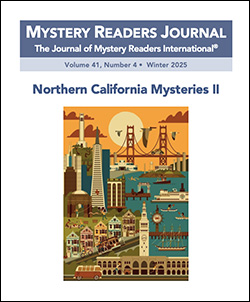
Buy this back issue! Available in hardcopy or as a downloadable PDF.
TABLE OF CONTENTS
ARTICLES
- They Didn’t Intend to Be Detectives… by Aubrey Nye Hamilton
- The Air Smelled Like Redwoods by Rona Bell
AUTHOR! AUTHOR!
- Northern California—in My Blood, in My Books by Juliet Blackwell
- A Time Traveler in the East Bay by Mary Adler
- Did a Charlie Chan Film Influence the Zodiac Murders? by Lou Armagno
- If You’ve Got the Lipstick… by David Corbett
- Climate Fiction in Northern California by Mary Flodin
- Just Say “Yes” to Stories from the Bay Area by Meredith Blevins
- Why I Set My Stories in Northern California by Daryl Wood Gerber
- San Francisco Wild by Toni Dwiggins
- Setting: Real or Invented? by Vinnie Hansen
- Mild-Mannered Men in Northern California by Walter Horsting
- I Have a Wild Imagination by Nancy Lynn Jarvis
- Following the Money to Silicon Valley by Ron Katz
- Baking Up Good Mystery in the Northern California Redwoods by Victoria Kazarian
- The Fault Lines in Northern California by Ellen Kirschman
- 1860s San Francisco— A Perfect Place for a Mystery by Nancy Herriman
- It Had to Be San Francisco… by Barry Lancet
- The City, My City by Lexa Mack
- World Building: It’s Not Just for Science Fiction and Fantasy by A.B. Michaels
- Feng Shui-by-the-Sea by Denise Osborne
- A Fog-Shrouded Lens by Tim Maleeny
- A Fish Out of Water in Oakland by Brad Parks
- The Babylon Deception, a Northern California Mystery by Ray Pace
- The Estuary Kept Its Secrets by Susan Paturzo
- Red Rock Island: Where Imagination Found a Home by Alec Peche
- The Cook, the Inspector, and the City by the Bay by Joanne Pence
- A Reader and a Writer Walk into a Bar by Karen A. Phillips
- Northern California: The Lost Highway by Alexandra Sokoloff
COLUMNS
- Mystery in Retrospect: Reviews
- Crime Seen: The Streets of San Francisco by Kate Derie
- Cop Ten: The Streets of… Everyplace Else but San Francisco by Jim Doherty
- From the Editor’s Desk by Janet A. Rudolph
If You’ve Got the Lipstick…
by David Corbett
Fifty yards ahead, a streetlight flashed red above the rain-hazed intersection like a robot in distress, its copper wiring gutted by thieves, and beyond that a vast abandoned construction site rose up the hill, an enclave of rebar and mud, shuttered within a chain-link fence topped with razor wire. Some tagger had written in spray paint across the side of an on-site trailer: Rio Mirada—If You’ve Got the Lipstick, We’ve Got the Pig.
That paragraph appeared in my fifth novel, The Mercy of the Night, to describe in part the fictional city I created to stand in for my hometown, Vallejo, California, located midway between the fog-bound towers of San Francisco and the vineyard-covered hills of the Napa Valley.
I’d used Rio Mirada before in two other novels, Done for a Dime and Do They Know I’m Running, as well as my novella, The Devil Prayed and Darkness Fell. With its storied history as a naval base, its rich mix of ethnic cultures—White, Black, Latino, Asian, Filipino, Pacific Islander and more—its dysfunctional politics (the first major US city to file for bankruptcy), its reputation for crime, its rabid police department, and its fledgling renaissance at the hands of artists fleeing the astronomical housing costs elsewhere in the Bay Area, it provided a microcosm of the larger region, with so much promise, so many problems.
For Done for a Dime I made use of a case my late wife and I had worked on, a probate matter involving a supposed son who showed up at the father’s funeral and approached the deceased’s only acknowledged child, our client, demanding half the estate. (We prevailed at trial.)
That novel prompted me to launch an extensive research effort on the town. I learned it had grown exponentially during World War II with an influx of Black families from the south to provide labor for the shipyard. A local developer who built houses for those families also financed the purchases, because no white-owned bank would lend to them. After the war the town became a mecca for blues and jazz musicians who played in local juke joints, and it produced sports heroes like Dick Bass of the Los Angeles Rams and C.C. Sabathia of the New York Yankees.
The closure of the naval base in the early 1990s sent the town into a tailspin since it served as the major employer and economic engine. Setting the story in that timeframe, when the city was “in transition” (to what, no one knew, and they likely still don’t) provided me a setting where everything was in flux, meaning financial control was up for grabs. Perfect for crime.
I also made use of my nephew’s expertise as an arson investigator, and by some strange coincidence, it turned out one of his mentors and the author of the definitive text on arson investigations lived right there in town.
Finally, I used the town’s rich musical history to create several of my main characters: Strong Carlisle, an aging blues-and-jazz musician; his gifted son, Toby Marchand; and the son’s girlfriend, a piano prodigy named Nadya Lazarenko.
The inspiration for The Mercy of the Night came from a famous case of child abduction in Vallejo. Midsi Sanchez was the second of two Latina eight-year-old girls abducted by a predator named Curtis Dean Anderson during a six-week period. He murdered first girl, Xiana Fairchild, though her remains were only discovered years later after he was convicted of abducting and sexually abusing Midsi over the three days of her captivity. She managed to escape when he dropped his keys and then flagged down a truck driver who took her to safety.
Unfortunately, she found it impossible to reintegrate into regular life, and by the time she was sixteen she had become addicted to drugs and had joined a gang. I based my main character, Jacqui Garza, on that struggling teenager, with some significant changes to Midsi’s background and home life, but retaining that theme of trying to find a place where you belong—and where people don’t automatically presume they know who you are.
As a co-protagonist I created a lawyer-turned-investigator named Phelan Tierney who’d met Jacqui while tutoring her at a local halfway house where teenage girls transition out of juvenile detention. When Jacqui suddenly disappears, Tierney dedicates himself to finding her, only to realize he’s exactly the kind of person she’s learned to distrust: someone with all the best intentions in the world.
Once the book came out, I located Midsi and gave her a signed copy. By that time she’d begun working as an advocate for other families with a child who’d disappeared.
For The Devil Prayed and Darkness Fell, I used another local story as the springboard. One of the most revered and distinguished Vallejo police officers was murdered by a suspect fleeing a bank robbery. The killing shocked the town—and six Black youths died in police-involved shootings the following year.
By that time I had done a lot of research on the Iraq War, and the PTSD and moral injury suffered by a great many returning vets. I wondered what if the fleeing suspect had been one such vet in the middle of a fugue state when he committed the killing. The story revolved around his sister’s attempt to get people to understand who her brother really is, and the local investigator—Phelan Tierney again—who works on her behalf.
Finally, Rio Mirada provided the home base for the Salvadoran family at the heart of Do They Know I’m Running. No local story inspired this novel, just the general situation of families facing the deportation of a loved one. I returned to a musical theme, though, and made my protagonist, Roque Montalvo, a budding superstar, “the next Carlos Santana.”
During the publicity tour for that book, a right-wing talk radio jock—in Portland of all places—took me to task for being “pro-illegal immigrant.” Screw that guy.
David Corbett is the author of seven novels, a short story collection, a novella, two writing guides, numerous scripts, and too many poems. A native Californian, he worked as a private investigator in San Francisco for 15 years. His work has been nominated for Macavity, Barry, Anthony, and Edgar awards. David and his wife, Mette, currently divide their time between upstate New York and coastal Norway.
Northern California: The Lost Highway
by Alexandra Sokoloff
I live in Scotland, now, starting my geographic transition in 2013 when I met my Scottish crime-writing husband Craig Robertson, and taking all the complicated steps to make my residence permanent in 2016—for obvious reasons. I am more grateful every day to be here. But California will always be home.
I grew up half in NorCal, half in SoCal, and Berkeley was the center of gravity of my world. My father researched and taught at UC Berkeley and it was my first school (experimental kindergarten!) as well as my alma mater (history and theater).
Scotland is amazingly similar to Northern California, in its stunning natural beauty and variations of wilderness (beaches, lakes/lochs, mountains, islands, rivers, forests, and lots and lots of wide-open vistas), its progressive politics and relaxed attitude toward religion, its commitment to conservation, the off-the-wall friendliness of the population, and the mythology that permeates the land and culture. The Wallace Monument, which I can see from my bedroom window, reminds me every day of an iconic NorCal monument from my childhood, the Campanile.
But of course I get homesick. So luckily for me, I get to visit my home state often in my books—I have now two mystery/thriller series and a historical serial all set mostly in Northern California.
One of my missions as an author and screenwriter is to take my readers/audience into a Special World—as mythologist Joseph Campbell named the numinous place of adventure, challenge, and spiritual growth that is the setting of the Hero/ine’s Journey.
Well, you can’t get much more “Special World” than Northern California. The towering ancient redwoods; the haunting cliffs and beaches of the coast; the five-fingered lakes that make up Shasta Bay; the alien (!) majesty of Mount Shasta; the misty, magical city of San Francisco with its collective dream of wealth beyond imagining that so many pioneers died—and killed—for.
Which makes that top half of the state a perfect book and series location for a writer like me—whose personal brand is crossing the crime genre with a bit of mysticism. I’m not writing overtly supernatural these days, but synchronicity, intuition, destiny, myth, magick—all these are part of the fabric of California and a thread that I not only want in my books—I’m not sure I could write about California without it!
Northern California informs my books politically, too. In the Huntress Moon series my FBI team is based in the San Francisco Bureau. They are diverse and liberal: Black, Anglo-Indian, a Vietnamese and Jewish gay couple—and the one white man is very woke. (Yes, I said it.) I find the tension between a conservative organization like the FBI and the progressive climate of the City an interesting dynamic to explore, as the team wrestles with their own sense of justice while they hunt an elusive woman who kills predatory men.
There’s also the aspect of San Francisco that the city itself is a living Western and US myth (which I explore in After the Gold Rush, my Substack about the fascinating real people and events that built San Francisco and the state). California has as bloody a history as the rest of the US—a land of genocide, horrific racism and exploitation against Native Americans, Chinese, Mexicans, Japanese and more; but at its best California has also given remarkable freedom and opportunity for women, LGBTQ+, and Black escapees from slavery and Jim Crow laws. As I’ve found in my travels, the state continues to fuel the imaginations and hopes of people all over the world, lately more than ever.
So I’m very excited to be able to return to San Francisco in person for Left Coast Crime in February 2026—a full circle moment, since I conceived the Huntress series at Bouchercon in San Francisco and used the Hyatt where LCC will be held as a crucial scene in Cold Moon. Now I’m coming back with the complete series—and introducing a new one!
The Lost Highway series that I’m writing with Craig (Book 1, The Grapevine, Blackstone 2026) is set all over California, north, south, east and west. Book 2 focuses especially on Humboldt County, which allowed me to mine a whole gold rush of childhood memories: Eureka and Arcata, the Redwood Highway, the Legend of Bigfoot road stop. Not just the wilderness settings, but the social issues of California come into play, including wilderness preservation, eco-anxiety, the nomadic life, prepping, the problem of the cannabis industry, the scourges of sex trafficking and homelessness—as indefatigable, plus-sized protagonist Lou Gomersall takes to the road in the family RV to search the state for her missing teenage daughter.
Because Lost Highway, like the Huntress series, is at its core a road trip series: the real location of both is The Road, a location and concept I lived for my whole childhood, growing up with two travel-obsessed parents—but never really thought about as a place unto itself until I was a student at Berkeley reading everything Jack Kerouac and Ken Kesey put to paper. And I realized I too am a citizen of The Road.
California is a magical, synchronistic, liminal homeplace for me. Berkeley is that, squared. And The Road may be the most Special World of all.
They all come together for me in Northern California.
Alexandra Sokoloff is the Thriller Award-winning author/screenwriter of the Huntress Moon thriller series and the Screenwriting Tricks for Authors workbooks/Substack; and the co-author with Craig Robertson of the upcoming Lost Highway mystery series. She also writes After the Gold Rush, a Substack novelizing California history.
Crime Seen: The Streets of San Francisco
by Kate Derie
Movies
San Francisco’s distinctive scenery has been a major element in a significant number of crime films. Here are a few of the best.
The Maltese Falcon (1941, John Huston) stars Humphrey Bogart in the Dashiell Hammett story of a private detective who gets involved with a deceitful dame, creepy criminals, and the pursuit of a priceless artifact. These elements, presented in a striking new cinematic style, became the template for innumerable subsequent genre films. Aside from a few establishing shots, the atmospheric S.F. locations were carefully reproduced on Hollywood sound stages. Rent at Amazon Prime Video.
Vertigo (1958, Alfred Hitchcock), with Jimmy Stewart and Kim Novak, features extensive Technicolor location shooting in San Francisco and nearby counties. The focus is on a psychologically damaged investigator whose phobias and obsessions incapacitate his ability to deal with the real world. Free at Prime Video.
Bullitt (1968, Peter Yates) was one of the first crime movies filmed entirely on location, taking thrilling advantage of S.F.’s steep geography in a car chase that set the standard for movies and video games (and probably sold a lot of Mustangs). Continuity errors? Who cares when the adreneline is pumping? Steve McQueen did his own driving. Streaming on Tubi (free with ads) or rent at Prime Video.
The Conversation (1974, Francis Ford Coppola) is a character study of a surveillance expert, played by Gene Hackman. From the vantage point of fifty years later, we also see the beginning of technological invasion of privacy, at the primitive stage of reel-to-reel tape recording. Extensive location shooting in San Francisco provides a rich contrast to the enigmatic secrecy of both the listener and those listened to. Free at Prime Video; also available from Hoopla and Kanopy (free streaming video services available through your library).
Warning: the following two films include graphic violence.
Dirty Harry (1971, Don Siegel) led the Seventies wave of iconoclast cop movies, making the film title a synonym for a vigilante with a badge. Clint Eastwood personified the smart-ass antihero who ignored the due process technicalities that many Americans thought contributed to rising crime rates. San Francisco was not just a gritty urban backdrop, it was a potent symbol of the counterculture and civil liberties that Harry and his fans rejected. Rent at Prime Video.
Zodiac (2007, David Fincher) takes the real-life case that inspired Dirty Harry and presents it in meticulous forensic detail. Mark Ruffalo plays dedicated lead investigator Dave Toschi, the antithesis of a gunblasting action hero, who is ultimately frustrated and unable to close the case. Because the crimes took place almost forty years before the movie, Bay Area exteriors are portrayed by a mix of actual locations, Southern California “stand-ins,” and studio reconstructions. Available on Netflix and Paramount+, for rent at Prime Video; also at Kanopy and Hoopla.
TV Series
Back in the days of crime-of-the-week programming (as opposed to “limited series” that take ten episodes to solve one crime), the whole family would meet up for favorite broadcasts such as these.
Ironside (1967-1975, 195 eps) marked the return of Raymond Burr, The Man Who Was Perry Mason. The show was a pioneer for its use of a disabled protagonist leading a diverse team, and addressed many contemporary issues. Although mostly filmed on Unversal Studios backlots, the show ensured that viewers were always aware of the S.F. milieu. All eight seasons now streaming on the Roku channel (free with ads).
The Streets of San Francisco (1972-1977, 120 eps.) was a classic police procedural that reflected the major cultural shifts taking place in the early Seventies. The partnership of Karl Malden and Michael Douglas was a major part of the success; so was the exciting location shooting. Seasons 3 and 4 are available free (with ads) on Pluto.tv.
Monk (2002-2009, 124 eps) starred Tony Shalhoub as a former SFPD detective, who became a consultant after developing OCD due to his wife’s murder. The show’s unique blend of humor and deduction made it popular with viewers and critics alike, gaining five Edgar nominations among many other award mentions. San Francisco appeared in the usual mix of soundstage and pseudo-location filming, with occasional use of genuine locations. Streaming free for Prime Video subscribers.
The Mentalist (2008-2015, 151 eps) honed his observational skills while pretending to be a psychic; now he’s a consultant for the fictional California Bureau of Investigation, headquartered in Sacramento. With a statewide jurisdiction, the CBI covers cases in many Northern California settings, both fictional and actual, but the show rarely filmed on location. Lead actor Simon Baker was nominated for several awards during the show’s run. Available at Hulu and HBO Max.
Buy this back issue! Available in hardcopy or as a downloadable PDF.