Volume 42, No. 3, Fall 2026
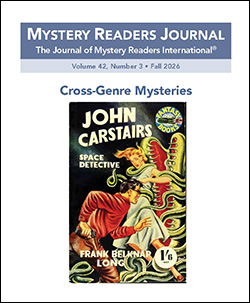
Buy this back issue! Available as a downloadable PDF or in paperback from Amazon.
Read the full version of Jim Doherty’s article “The Law West of the Mississippi” (PDF).
TABLE OF CONTENTS
ARTICLES
- Books That Blend Crime with Speculative Fiction or Dark Romance by Ada Marie Saber
- Walking the Dark Crossroads of Magic and Crime by Ayo Onatade
- The Mean (and Dusty) Streets of Luke Short by Randal S. Brandt
- The Love Detective by Ashley Bowden
AUTHOR! AUTHOR!
- A Western/Hollywood/WWII Historical/Charlie Chan Adventure by Lou Armagno
- Literary/Mystery or Drama/Mystery? by Paul A. Barra
- The Mechanics of Steampunk and Mystery by Shelley Adina Bates
- What the Heck Is “Genre,” Anyway? by Juliet Blackwell
- Crossing Genres Can Be Fun, but It’s Not Always Easy to Do by R.G. Belsky
- Psychics, Ghosts, and Witches, Oh My! by Kris Bock
- Baking Magic into Mysteries by Jennifer Chow
- The Risk and Reward of Cross-Genre Fiction by Brian Cox
- A Bedtime Story by Barbara DaCosta
- An Unexpected Twist—For the Author by Jacqueline Diamond
- Death Like You’ve Never Met Her Before by Veronika Dapunt
- Solving the Mystery of Writing Cross-Genre by Maxie Dara
- A Mysterious Transformation by Yves Fey
- Choosing to Change: The Many Genres of My Horror Debut by Kennedy Cole
- My Ghost Mystery by Kaye George
- We Did a Genre Mash (It Was a Graveyard Smash) by Kat Hillis and Rosiee Thor
- Character Assassination by Sarah Lotz
- James Bond Goes West by Scott McCrea
- Partners in Crime(-Solving): Romance in the Mystery Novel by Jackie McMahon
- Murder, Magic, and Merry Christmas: My Love Affair with Cross-Genre Fiction by Kevin Moore
- Moloch and the Angel by Pat Morin
- The Apology Writer: When the Mystery Is Not Only What Happened by Apryl Morin
- The Trial and Tribulations of Researching Life—and Death—in 1734 by Donalee Moulton
- Speculative Detectives and the Importance of Mixing It Up by Richie Narvaez
- Genre Subversion in Gumshoe Frankenstein by Paul Ryan O’Connor
- Mystery Mash-Up in the Wild Wild West by Ann Parker
- Myself on a Shelf by Annelise Ryan
- Cross-Genres are Great Opportunities by A H Scott
- Writing Across Genres by A.L. Sirois
- Crossing Genres in the Classroom by Art Taylor
- A Whisker of Murder and Romance by Jaden Terrell
- Add a Little Supernatural Zest for a Delicious Reading Experience by Vikki VanSickle
- Adult–YA Crossovers: A New Genre or Familiar Fiction? by Nancy G. West
- Crossing Over: Flirting With the Future by Bruce Wetterau
- A Simple Crossover Recipe by N.S. Wikarski
- Traditional Mystery Series with a Science Fiction Flavor by Dave Zeltzerman
- Emerald Love: Shape-Shifting Country Music Star As Sleuth by Elizabeth Zelvin
COLUMNS
- Mystery in Retrospect: Reviews by Lesa Holstine, Dru Ann Love, Craig Sisterson, Lucinda Surber
- Children’s Hour: Cross-Genre Mysteries by Gay Toltl Kinman
- Cross-Genre: Mysteries and True Crime by Cathy Pickens
- Crime Seen: Genre Segue by Kate Derie
- The Law West of the Mississippi by Jim Doherty
- From the Editor’s Desk by Janet Rudolph
Crossing Genres Can Be Fun, but It’s Not Always Easy to Do
by R.G. Belsky
I’ve published more than 25 mystery novels in my writing career, all of them up until now the traditional kind in the mystery genre.
Then, earlier this year, I crossed genres for the first time—putting out a paranormal thriller called The Vanishers, about a seemingly perfect summer beach house where people in the house start disappearing because of supernatural forces, without a trace that they ever even existed.
“Wow, you really combined two genres here!,” readers have commented to me. “After all these years, you try something so different. How did you come up with this idea to write a supernatural thriller?”
The answer to that is… well, interesting.
Many years ago, after I published my first mystery novel, I got an agent who was waiting to see my next mystery.
Back then, I was reading all the great mystery writers for inspiration—Raymond Chandler, Ross Macdonald, Agatha Christie.
But I was also reading a lot of Stephen King novels. Especially the ones where he mixed supernatural elements with a traditional thriller type story, like The Dead Zone and Firestarter.
I got so enthused by this I decided to do the same thing—and write a second book called The Vanishers which combined a traditional mystery story with supernatural elements by setting it in a creepy old house where’s people just keep vanishing into thin air, along with any memory they ever existed.
As the story goes on, it gets even more into the supernatural area with alien abductions, mind-altering technology and even a flying saucer or two.
I was already a big fan of TV shows like Twilight Zone and Outer Limits—and would go on to love shows like The X-Files years later.
I finished the novel, but when I showed the book to the agent she told me it was a ridiculous story. “None of this is real. It’s all impossible to believe. Why would you write this instead of another mystery? Just forget about this paranormal/sci-fi nonsense and write a mystery novel.”
And that’s what I did. I put this book—The Vanishers—away in a closet and kept writing mystery novels for years. Series. Mini-series. Standalones. All of them were traditional mysteries.
But the thing is I never throw any manuscripts away. So when a friend who turned me on to The X-Files found out I’d written a novel in a similar vein, she wanted to read it. I dug it out, gave it to her and got the same basic response I had gotten from the agent. “It’s just too out there,” she said.
But I’m stubborn, and I still didn’t completely forget about this book—even though I went back to focusing on mystery novels.
Fast forward now to present day, and I tell another person in the publishing world that I have a Stephen King-type supernatural thriller. She gets back to me with the same message: Forget about writing sci-fi, paranormal or supernatural stuff and just write another regular mystery.
But then I discovered another writer who does cross-genres by combining supernatural stuff with a traditional thriller. His name is Riley Sager (The Final Girls, The House Across the Lake) and more like that which have been super successful. I got a chance to interview Sager and I read his books, then decided to give it one more try with my own supernatural thriller, The Vanishers.
I have an author friend who’s been dealing with a new publishing company in Europe called dp Digital Publishers. She said they accepted submissions on their website even if I couldn’t convince an agent to represent this one. And so I sent it to them, not really expecting much after all the negative comments about the cross-genre theme.
But guess what?
They bought it.
And so this past May, The Vanishers was published in ebook and print in the US and UK. DP has now decided to do a German translation of the book too. And I was able to sell the audio rights to Podium Entertainment in Los Angeles, which is releasing the audiobook version in September.
So don’t let anyone tell you that crossing genres can’t work.
I found that out in the end.
Even if a lot of people disagreed along the way.
A cross-genre book can be fun.
For the reader.
And for an author like me and who takes a chance to do something different—and write one!
R.G. Belsky is an award-winning author of crime fiction and a journalist in New York City. His latest book is The Vanishers, a paranormal thriller about people suddenly disappearing from a summer beach house. He also writes the Clare Carlson mystery series, about a woman journalist who works for a New York City TV station. Belsky has published more than 25 novels—most of them set in the New York city media world where he has had a long career as a top editor at the New York Post, New York Daily News, Star magazine and NBC News.
Baking Magic into Mysteries
by Jennifer Chow
I love baking, not only because it’s so relaxing and you get a delicious treat at the end, but I appreciate the entire process. There’s enchantment to layering ingredients in a certain order and making something tasty, as if by magic, appear.
One of my favorite treats—both as a kid and now—is the fortune cookie. I enjoy its vanilla-infused flavor along with the intricate, twisted form. What’s most delightful about the fortune cookie is the message inside; it can provide wondrous insight or perplexing commentary. It might not be surprising, then, to learn that I’ve collected numerous fortune cookie sayings over the years.
My personal inclination for yummy treats, interesting twists, and pure delight coalesced into the formation of my Magical Fortune Cookie novels. In this series, I’m able to introduce baker Felicity Jin, who sleuths in the little town of Pixie when she’s not busy baking. (And of course, there are recipes in the back of the books.)
Like a typical culinary cozy mystery, the stories feature mouthwatering scenes in the kitchen and a close-knit community, including her loving mother, Angela Jin, and the handsome florist neighbor, Kelvin Love.
In a parallel to baking, there are also layered ingredients with this series. I’ve combined the cozy with the magical in these books, crossing genres. The treats in the bakeshop are delicious, but they’re also charmed; they bring immediate joy to all who eat them. The baking legacy has been passed down for generations in the Jin family, from mother to daughter, and each magical baker has their own signature treat. Felicity’s recipe is for the fortune cookie, but her baked good has an unexpected and enchanted twist: her cookies bring happiness while her messages bring true predictions.
Unfortunately, in the first book in the series, Ill-Fated Fortune, the message the customer gets is an unlucky one. It predicts the manner of his death, and that’s exactly how he’s found—and in the alley behind the Jins’ bakery. Now at the top of the suspects list by the police, Felicity must figure out what really happened to the poor customer.
While Felicity learns to wield her new power, she encounters even more magic in her life. This includes her newfound pet Whiskers, a bunny who descends from the moon to be her charmed companion and help her understand magic better.
Moreover, in the latest Magical Fortune Cookie book, Tell-Tale Treats, the magical rules expand beyond Felicity. Her love interest, Kelvin, also appears to be experiencing strange, extraordinary sensations after baking with her.
Tell-Tale Treats involves a group of alumnae (think: Mean Girls but grown up) whose queen bee dies unexpectedly during their retreat at a quaint inn. It’s up the magically heightened trio of Felicity, Whiskers, and Kelvin to set things right.
What’s so fun about mixing magical realism with mystery is that it enlarges the world. Instead of the exterior surface, there’s an underneath network of goings-on and rules at play. Plus, the community has expanded beyond earthly residents and common items to include enchanted pets and magical cookbooks.
Just like a complex baked good features layers of ingredients that result in a grander treat, I hope writing across genres results in a greater book, delighting the literary taste buds of many readers. What I do know for sure is that crossing genres makes for a twistier plot as I intertwine the magical and the mundane into the story. Plus, there’s a special kind of writerly pleasure when adding charmed creative ingredients to my recipes for novels.
Jennifer J. Chow has been a finalist for the Agatha, Anthony, Lefty, and Lilian Jackson Braun Memorial Award. She writes cozy mysteries filled with hope and heritage, including the Sassy Cat, L.A. Night Market, and Magical Fortune Cookie series.
Buy this back issue! Available as a downloadable PDF or in paperback from Amazon.