Volume 42, No. 2, Summer 2026
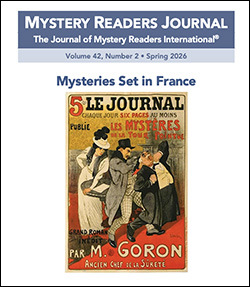
Buy this back issue! Available as a downloadable PDF or in paperback from Amazon.
TABLE OF CONTENTS
ARTICLES
- Joseph Rouletabille: Reporter-Detective by Ashley Bowden
AUTHOR! AUTHOR!
- Vive la différence! by Cathy Ace
- From Marseille to Edisto Island by Paul A. Barra
- We’ll Always Have Paris by Janet Dawson
- From Somewhere in France by Michele Drier
- A Historian and Novelist in France by Ann Elwood
- Delicious Chapters by Yves Fey
- What Foolish Dreams May Come by Alan Gordon
- The Eat, Drink, and Be Merry Research Tour: Setting a Book in France by Wendy Hornsby
- It’s Never Too Late to Be a Midlife Badass by Lauren Johnson
- I’d Kill to Live in Paris by Eva Jurczyk
- The Mystery of the Misplaced Mona Lisa by Ron Katz
- Victor & Me in Paris by Janice MacDonald
- It’s All About the Setting by Adrian Magson
- Magdalene Duchateau: A Frenchwoman Abroad in the English Mystery by G.M. Malliet
- Murder at Villa Légère: A Pho of Murder, Diamonds, and a Secret Worth Killing For by C. L. Malone
- Why France? by Peter May
- France Is a Drug—The Bennett Sisters Can’t Be Wrong by Lise McClendon
- Liberty and Death in the French Maritime Alps by Larry Mild
- My France by Sharan Newman
- The Reality Behind the Fantasy of “French Country Murders” by Katie Penryn
- Corsica: Where Landscape Creates Secrets by Neil S. Plakcy
- Mysterious (and Delicious) Paris by Danielle Postel-Vinay
- Paris Didn’t Let Me Leave, So I Wrote a Murder Instead by Ileana Muñoz Renfroe
- Why Not France? by Susan C. Shea
- Mysterious Paris by Rob Swigart
- So Softly Threads the Night by Bob Van Laerhoven
- The Mystery of Paris by Charles Todd
- I Was a Free Man in Paris by C.J. Verburg
- We’ll Always Have Paris by Nancy Warren
- Dreaming of Paris by Victoria Zackheim
- Saint-Paul-de-Vence: Toujours Cool, Just Add Murder by Elizabeth Zelvin
- On Monaco and Mystery by Ally Zetterberg
COLUMNS
- Mystery in Retrospect: Reviews
- Children’s Hour: Mysteries Set in France by Gay Toltl Kinman
- Meurtres en … France by Kate Derie
- Spiral (Engrenages): France’s Compulsive Masterpiece of Crime, Corruption, and Character by Pattie Tierney
- Jean Gabin—the Greatest Maigret by Jim Doherty
- True Crime France by Cathy Pickens
- From the Editor’s Desk by Janet Rudolph
Why France?
by Peter May
Born and raised in Scotland, I’ve written seven books set in France and it has been my home for more than a quarter of century.
So, why France?
Was it reading about the life of Hemingway? Expat writers and intellectuals living the high life in Paris on limited means; self-destruction and creative genius fuelled by house wine, Gitanes and absinthe.
Was it family vacations? French camping holidays every year, touring rural France and walking the cobbled streets of medieval villages where characters, history, and stories fill every step.
Was it the wonderful rustic cuisine to be found in country restaurants? Or the chance to visit legendary vineyards and meet the winemakers behind iconic labels? What’s better than lunching in a little bistro in the square of the tiny village of Puligny-Montrachet and being served its world-celebrated wine in an earthenware jug?
Or was it the fact that no matter what you are looking for, France has it? You can laze on a beach on the Côte d’Azur; rent a fisherman’s cottage on a Breton island; ski in the Alps; climb volcanic peaks; take boat trips through spectacular gorges; stroll through thousand-year-old castles and know that for ten centuries, generations of men and women warmed themselves by these fireplaces and walked on these flagstones.
Maybe it was the combination of all of these things. By the time I was in my mid-thirties, I had swapped the annual campsites for a 15th- century bell-ringer’s house in a village in southwest France. A vacation retreat, to take me away from the high-stress world of writing television drama. Over a period of fifteen years I escaped there whenever I could with my wife, writer Janice Hally. We worked together on more than a thousand episodes of television serials as creators, scriptwriters, storyliners, script editors and latterly for me, as a producer. Rural France was our quiet place, away from deadlines and viewing figures and ratings wars.
Then, in the midst of loss and grief, France became a refuge where we would rebuild our lives.
In the mid-1990s, we quit television so that I could fulfil my lifelong ambition of writing books. During the four years leading up to the new millennium, I embarked on researching and writing my China thrillers. But some greater force decided I needed other challenges—my father’s dementia, my wife’s miscarriage, and the deaths of all four of our parents in a traumatic five year period. It was a bleak and difficult time. We found ourselves retreating to France. We bought a bigger house, not just for vacations, but to live in. Time to begin a new chapter.
After six China thrillers, I turned my thoughts to a new setting. Location had always been important to me, but it was time for a change.
Looking back on Scotland from afar, gave me the perspective to write The Blackhouse. I poured my heart and soul into it, only to have it turned down by every UK publisher. I was devastated, until I let my French publisher read it. She “adored” it. She bought world rights and published it first in France, and in French. It was declared “a masterpiece” by the newspaper L’Humanité and won multiple literary awards in France. It was eventually published around the world and ended up winning the US Barry Award. That breakthrough changed my life.
After writing about Scotland, I turned my sights to my adopted homeland.
Living in a country is different from visiting it. You absorb its rhythms, its habits, its ways of thinking, and yet a small part of you always remains detached, observing. Living in France has given me an insider’s understanding, but I still retain an outsider’s curiosity. I notice things that might escape someone born and raised in the country. The quirks, the contradictions, the small details that bring a place to life on the page.
France is a country layered with stories. Every village square, every crumbling château, every stretch of vineyard holds secrets. And I began to wonder what might happen if those secrets no longer stayed buried, but were instead dug up by some curious investigator. Someone who, like me, is a bit of an outsider.
Enzo Macleod is half-Scottish, half-Italian, with a French daughter, and entirely at home in France—though perhaps never fully belonging. Someone with more than a little pain in his past, but a survivor, dogged and determined. Formerly a top forensic scientist, he is now a professor at a university in Toulouse. France has been his home for twenty years.
The series begins with Enzo foolishly accepting a bet that he could use modern technology to solve seven of France’s most notorious cold cases. Each investigation takes Enzo to a different corner of France, from the intellectual elite of the École Nationale d’Administration in Paris to the vineyards of the south-west, from the European Parliament in Strasbourg to the headquarters of the Foreign Legion in Provence.
To travel through France with Enzo is to immerse yourself not only in the investigation of a crime, but in an exploration of French life—the history, the landscape, the culture and the cuisine.
Having taken French nationality, I now hold a French passport (that’s a whole story for another time). I have gone from what one interviewer described as the “most French of all Scotsmen” to being the “most Scottish of all Frenchmen”. And last year, I was awarded the Grand Prix de Littérature Policière, France’s top prize for crime writing.
My adopted country has adopted me and I couldn’t be more proud.
Peter May is a Glasgow-born Scottish crime novelist, screenwriter and former journalist who now lives in France. He is best known for the internationally successful Lewis Trilogy, set in the Outer Hebrides, as well as the China Thrillers and the France-based Enzo Files. His books have won major crime-fiction awards in France, Scotland, the UK and the US, including recognition for The Blackhouse and Entry Island.
France Is a Drug—The Bennett Sisters Can’t Be Wrong
by Lise McClendon
Fourteen years ago, the last time I wrote about France and mysteries for this magazine, I had only one mystery that qualified, Blackbird Fly. Set in a fictional bastide village in the Dordogne, that novel was intended to be the start of a series but it didn’t turn out that way— at first. It took five years and a walking tour of Burgundy by the author—moi—to finally jumpstart the adventures of the five lawyers in the Bennett Sisters Mystery series.
Walking through vineyards, cycling along country lanes, picking poppies and inhaling lavender, experiencing the French countryside up close and slowly, was more than enough to get me back into the series mode. And the French mode. It also inspired the plot of the second book, The Girl in the Empty Dress, where one of the trekkers, a mysterious colleague on a Bennett Sisters tour, finds an injured truffle dog by the trail and all well-laid plans go out the window.
Southwest France, where many of the books are set, is a magical place, less explored by Americans but very popular with Brits. What do I love about the region? The history (the Hundred Years War still visible), the truffles, the foie gras, the wine, the remote hilltop villages. Since 2003 when I went on my first research trip I have been to the region many times, exploring new backwaters, having my own adventures. (Do not ask why I rented that stick shift and couldn’t figure out reverse!) But the whole esprit de France is something I can’t explain. You have to experience it and when you do, your life will be so much richer. Promise.
Take the food. French cuisine is luckily something we can create anywhere. However it is said by some that food tastes better in France. That is possibly due to the fact we are in France and on vacation! But also keep in mind the care taken to provide the highest quality ingredients, fresh and organic, prepared with expertise and finesse, whether by home chefs or in bistros. I have incorporated many meals into my novels about the Bennett Sisters and some years ago published a small cookbook featuring recipes for many of the mentioned dishes. I give it away (you too can get one by subscribing to my newsletter at lisemcclendon.com) but it is also a meditation on delicious meals that the French savor and we Americans seem to hurry through. I am working now on an expanded edition, out later in 2026.
Although I do have a couple of books set in Paris (Blame it on Paris [2018] and A Bolt from the Blue [2019]), most of my French settings are in the Aquitaine, the region of southwest France. While the main character, Merle, the middle sister, inherits a cottage in the Dordogne, things move forward over the 22 books so that she and her wine fraud detective partner now own a vineyard in Sainte-Foy, a winemaking region just west of the Dordogne in the Bordeaux AOC. Where you grow your grapes and make your wine is a very big deal in France.
So, yes, wine too makes a big, juicy splash in the stories. The French take wine very seriously, protecting regions against fraud with a government agency that does nothing but investigate crimes against the label. Pascal d’Onscon, the detective, moved on from Blackbird Fly as a summer fling for Merle Bennett to being a well-loved character who stars in his own books, Dead Flat, Monsieur Moonlight, and Château des Corbeaux, the latter being the name of the vineyard he buys.
One might think that wine fraud is a narrow topic for crime novels, even in France. But crimes of fraud against the wine consumer, because of the difficulty of identifying exactly what type of wine is in a bottle, are legion. Tales of billionaire connoisseurs being duped run rampant. The industry is large, prized, and highly regulated in France. The French have their own wine laboratory at Cité du Vin, an impressive modern facility in Bordeaux that is definitely worth a visit.
When I started Château des Corbeaux (2021) (Castle of Ravens in English), I decided I needed to know more about running a winery. I took a short online course and learned quite a bit, but not enough to actually grow grapes and make wine. That, like my dream of living in France, is just a dream. So many Americans are moving to France now. Why? Is it the lifestyle, the long meals, the leisurely walks, the lavender, the wine, the lemons, the sunshine? Oh, the healthcare. It’s not the crime, unless it’s the crime they leave behind. France is not a paradise. There is, of course, crime in France and in many of the mysteries you are reading about here.
The first book in the series kicks off Merle’s journey. Blackbird Fly contains a mystery but reads more like women’s fiction, where a midlife woman reinvents herself, learns to live with grief and her own failures, and rediscovers a love of living that her work ethic denied her. That to me is the essence of the French lesson. Don’t deny yourself the beauty and wonder of life by grinding away at work 52 weeks a year.
In this excerpt from The Frenchman, Merle contemplates France:
At dinner that night she confessed to Pascal that she considered France a drug. That it cured people of their illnesses, erased the worst of the modern age, the crass commercialism, the puritanical outrage, the hyper-religiosity, the need to constantly judge other people. Pascal was drinking a soft Côtes du Rhône. He stared at her for a second when she stopped then burst out laughing.
“You are so earnest? But you don’t mean that.”
“Yes, I do. There is a definite therapeutic benefit from just being in France.”
“It cures you? You are changed? Through the air? … France is not a drug, ma chérie. The people who think France is a gastronomic Disneyland full of sunflowers, they are the ones who will take us back to the past, to an age that never happened except in their own minds.”
“Back to Madame Guillotine?”
“And worse.”…
She knew she was being silly about France being a drug … of course France didn’t cure what ailed you unless what ailed you was a pasty complexion and a hankering for goose liver.
And yet. Don’t we wish? I love working out the American-in-France angle. The series continues. I am publishing a short novel this year (The Thing About Amanda follows the events of Give Him the Ooh-la-la), and possibly a long one set in Sainte-Foy. And that cookbook.
Too much? I try to take that French philosophy to heart, and enjoy life. If it means I write fewer books, so be it. Because France is always calling and I can’t say no.
Lise McClendon has written 22 mysteries in the Bennett Sisters Mystery series, with more to come. She also has series set in Jackson Hole, Wyoming, and World War II Kansas City. She has been the editor of many anthologies, including the 2025 mystery collection, Deadly Yellowstone, based on the national park near her home in Montana.
My France
by Sharan Newman
A friend of mine once asked to come to Paris with me on my annual research trip. “We can walk along the Seine and you can tell me what your characters are doing.”
I blinked. I thought of modern Paris. My characters lived in the 12th century. The only building near the Seine that they would have known is the church of Saint-Julien-le-Pauvre. There was no Louvre, no Eiffel Tower, no wide boulevards. Notre Dame was 500 years old and in ruins. Dozens of small streams crossed the city, bringing fresh water to the Seine. Streets were narrow, houses packed together. The air was full of the sounds of tradespeople hawking milk, bread, beer, fish, meat, and anything else local people might need or want. Added to these were shouts as cargo was unloaded at the river and the loud lectures of philosophers competing for students. My characters would be lost in the modern city. Added to this, that’s not the way writers work. I wish it were.
So, there aren’t many landmarks in Paris for me to point out to readers or tourists. My time there consists of taking the Metro to the Bibliothèque Nationale, going down through a series of security gates to where the books or manuscripts I ordered are waiting for me. I stay there all day, stopping to have lunch at the secure café. I then take the Métro to the studio apartment I rent, get food for dinner (and wine) and crash. Sometimes I meet up with friends for dinner, but mostly it’s studying and taking notes.
Also, many French friends have told me, “Paris is not France.” It’s like assuming that Los Angeles is a typical American city.
My first mystery, Death Comes as Epiphany, does take place in Paris, mostly. But for research I used other towns that were small and hadn’t been renovated. Auxerre, Flavigny, Autun, Alise-Sainte-Reine in Burgundy are all full of buildings that were standing in the 12th century. The layout of the villages is also similar.
In Flavigny I stayed in a roughly converted stable, with lanterns for heat as well as light. Water was from a pump over a stone sink. Dinner was melted cheese over apples, cooked over sterno. OK, not completely medieval, but the atmosphere was perfect.
The next evening, I ate at a local pub/restaurant. Walking home in the dark through the narrow streets, I heard a quiet shuffling behind me. When the chanting started, I looked around. In the evening fog I saw a group of hooded monks who seemed to be singing Compline. This was more medieval verisimilitude that I was prepared for and I walked very quickly back to my stable.
The next day I learned that there was a small monastery on the edge of Flavigny and the monks often processed through the town before bed.
Ghostly scare aside, I felt that I was closer to life in the Middle Ages than I ever could be in Paris.
If I were to take friends through medieval France, we would go to these towns and more like them. For Strong as Death, which follows the pilgrimage route to Santiago de Compostela, in Spain, my guidebook was one written in the 12th century. I went to Conques, with its church of Sainte-Foy, a Roman martyr. It’s a fabulous example of medieval images of hell, mixing terror and humor as rabbits carry a damned hunter to his just reward. As we crossed the Pyrenees, my guidebook warned me about the Basques, who were violent barbarians who dressed in short robes that bared their knees! It also warned me about the greedy landowners who charged poor pilgrims outrageous prices to cross rivers. Some things never change.
In my books, I try to give readers a sense of life in medieval France. There was such a variety of customs and beliefs. It was not the monolithic world the so many people presume. I focus on a merchant family because not many people lived like royalty.
While a mystery can weave aspects of daily life into the story, there is so much that can’t be fit into the plot. One of the threads I use is the Jewish/Christian relations at the time. Many communities had small Jewish populations but some, like Troyes, were centers of scholarship. Jews in Lunel, in Languedoc, formulated the beginnings of the Kabbala.
I could ramble on forever. It would be wonderful to show visitors my France. For those who prefer modern Paris, Cara Black writes a wonderful, gritty, series set in various areas of the city.
For my part, I’ll keep wandering the backroads, seeking the sites that remain from 800 years ago, trying to get as close as possible to the people from that time.
Also, the food and wine are incredible everywhere. Paris is not France.
Sharan Newman is a medievalist who thinks Western Civilization ended in 1214. She writes the Catherine Levendeur mysteries, set in the 1100s, which are intriguing enough for a lifetime. She also wrote a trilogy about Guinevere and, in an aberration, The Shanghai Tunnel, about her hometown of Portland, OR. All of these are still in print. She lives in the West of Ireland now and loves it.
Buy this back issue! Available as a downloadable PDF or in paperback from Amazon.