Volume 42, No. 1, Spring 2026
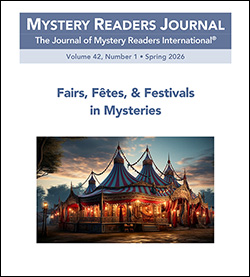
Buy this back issue! Available as a downloadable PDF or in paperback.
TABLE OF CONTENTS
ARTICLES
- May Day, Maypoles, and Morris Dancing Mysteries (and a Recipe for Maypole Chocolate Cake) by Janet Rudolph
- The Fête of Mortals—The Trigger for Crime by Alan Cassady-Bishop
- Graham Greene: The Man for a White Elephant Stall by Moira Redmond
AUTHOR! AUTHOR!
- The Welsh Have a Word for It… by Cathy Ace
- Murder Can’t Stop de Carnival—or Writing About It! by Ashley-Ruth M. Bernier
- Spectacles, Sangria, and Selkies by Rowan Dillon
- Celebrating Crime on the Page, with the Food Lovers’ Village Mysteries by Leslie Budewitz
- There is Nothing Better Than a Fair or Festival by Nancy Coco
- Searching for Carnevale by Yves Fey
- Faire at a Fire Station Sparks a Mystery Plot by Nancy Lynn Jarvis
- Summer Festivals Are Hot in a Wintry City by Janice MacDonald
- Why I Set My Murder Mystery at an English Literary Festival by Mark McCrumb
- World’s Fairs as Bookends to a Mystery Series by Frances McNamara
- Asian Festivals & Fairs by Larry and Rosemary Mild
- It Takes a Village Fair: Setting the Stage for Murder by Paula Munier
- Murder Under the Bunting: Festivals as Crime Scenes by Neil S. Plakcy
- Round and Round: Why We Can’t Resist a Carousel by Bernard O’Keefe
- Murder Midst the Bunting by Ann Sutton
- Mardi Gras State of Mind by Martha Reed
- Come Taste My Wine: The Balmetto Festival in Borgofranco d’Ivrea by D.R. Ransdell
- What’s Fair About It? by Nancy Wikarski
- Comic Cons Make Murder Mysteries More Fun! by Melissa Westemeier
COLUMNS
- Mystery in Retrospect: Reviews by Lesa Holstine and Aubrey Nye Hamilton
- Children’s Hour: Fairs, Fêtes, & Festivals in Mysteries by Gay Toltl Kinman
- Real Crime at Fêtes and Festivals by Cathy Pickens
- Crime Seen: Fun—and Fear—at the Fair by Kate Derie
- From the Editor’s Desk by Janet Rudolph
The Welsh Have a Word for It…
by Cathy Ace
Gŵyl is the Welsh word for “festival”, but if you were to look up “Welsh festivals” online you’d be inundated.
The Welsh love a good old knees-up, and some of their excuses for celebratory gatherings have been around for a very long time indeed. Born and raised in Wales, I migrated to Canada aged forty, so I’ll always be Welsh, and—like all immigrants—I’ll always be “becoming” my new nationality. Aiming to bring the Wales I know and love to readers around the world via my writing, I’ve created a fictional Welsh village, with its local stately home, that’s at the heart of one of my series (the WISE Enquiries Agency Mysteries), and readers who accept my invitation to the Welsh village of Anwen-by-Wye get treated to at least one Welsh traditional festival, fête, or celebration in each book.
Take those traditions which surround what was originally celebrated as the Winter Solstice, which then morphed to surround Christmastide, for example—there are so many of these that I’ve had to split them up across several books to allow time for any puzzling crimes to be solved in my tales. For example, Druids once hunted wrens—those tiny birds which are a delight to behold in the depths of the winter months—sacrificing the little creatures, known as “The King of the Birds,” to “bring back the sun.” The tradition continued in Wales (it’s well documented in Cardiff in the mid-1800s, for example), though in Pembrokeshire they didn’t kill the wren, but tied ribbons on it and then carried it in a box to everyone’s house on Twelfth Night.
Althea Twyst—the dowager duchess of Chellingworth who features in these books, who’s often the catalyst for reviving or highlighting ancient Welsh traditions in the series—organizes a type of “Wren Hunt” in The Case of the Unfortunate Fortune Teller, but with tiny, fake, stuffed wrens hidden in man-made “trees”. Althea also sets up an Alban Arthan, where men act as the Holly King mock-battling the Oak King; the Oak King—who reigns from midwinter to midsummer—always defeats the Holly King, who then gets to reign over the other half of the year.
Some other celebrations are wonderful and joyous, and several took place in The Case of the Absent Heirs: Noson Gyflaith—the tradition of spending Christmas Eve pulling taffy (toffee), and Plygain—a celebration of music where solos, choruses, and even instrumental music are performed for hours, with nothing repeated. Then there’s the Mari Lwyd, where a horse’s skull is held on a stick, the carrier hiding beneath a sheet, as a group goes from door to door challenging a home’s occupants with rhymes—like a rap-throw-down; the wassailers are rewarded with beer if the homeowner cannot reply. Then there’s Calennig, where an orange is delivered to a home—again with rhymes being spoken and songs sung—to welcome the new year.
These are just a few of the Welsh celebrations which I’ve managed to slip into my WISE Enquiries Agency Mysteries—while also allowing for puzzling crimes to be solved—along with many others across the series, including St. David’s Day (Dydd Gŵyl Dewi), the National Eisteddfod (Eisteddfod Genedlaethol) which is an annual national festival of song, poetry, dance and the arts in general, and—of course—Halloween (Nos Galan Gaeaf) with its ancient ghoulish delights, prominently featured in The Case of the Disgraced Duke.
If learning about Welsh festivals appeals to you, I invite you to explore them with the women of the WISE Enquiries Agency… where traditions blend with cozy crimes as seamlessly as they do with mountains of Victoria sponges and gallons of tea!
Cathy Ace’s Cait Morgan Mysteries feature a globetrotting Welsh Canadian criminal psychologist who solves traditional whodunits alongside her retired-cop husband, Bud Anderson (Eve Myles will portray Cait in the TV production by Free@LastTV). Her WISE Enquiries Agency Mysteries feature four ‘softly poached’ female PIs solving cozy cases from a Welsh stately home.
It Takes a Village Fair: Setting the Stage for Murder
by Paula Munier
All things that we ordained festival,
Turn from their office to black funeral…
—William Shakespeare
There’s nothing more murderous than a village fête.
Think Saint Peter’s Fair in the eponymous novel by Ellis Peters, the Up Helly Aa festival in Raven Black by Ann Cleeves, the Monongahela County Fair in Annette Dashofy’s Fair Game. Not to mention every other episode of Midsomer Murders—from the Little Crosby Folk Festival and the St. Michael Literary Festival to the Pilgrim’s Ride Bicycle Race and the Angel’s Rise Psychic Fayre, just to name a few of the Midsomer galas marred by homicidal maniacs and serial killers.
Such occasions are grand settings for murder and mayhem. The capricious air of celebration, the awkward intermingling of locals and tourists, the infighting behind the scenes, the long-simmering rivalries in the fierce competition for biggest pumpkin, longest beard, fastest pig.
Plus: 1) Food—BBQ, pie, and deep fried everything; 2) Drink—craft beer, hard cider, and Del’s frozen lemonade; and 3) Arts and crafts and games—chain saw carving, taxidermy, chessboxing, and more.
All grist for the murder mill when you’re a mystery writer. Especially if you’re writing mysteries set in New England, where fêtes, fairs, and festivals are as ubiquitous as sugar maples, clam chowder, and frigid winters. Here you’ll find every possible kind of event, celebrating everything from jazz (Newport Jazz Festival) and lobster (Maine Lobster Festival) and livestock (Martha’s Vineyard Agricultural Society Livestock Show and Fair) to hot air balloons (Quechee Hot Air Balloon Festival) and Halloween (Salem’s Haunted Happenings) and Shakespeare (Vermont’s Shakespeare in the Woods).
My Mercy Carr mysteries are set primarily in Vermont, in a mythical small town called Northshire, somewhere in the Green Mountains in the southwestern part of the state. A quintessentially quaint Vermont village, with 17th–, 18th–, and 19th–century homes and shops lining streets with marble sidewalks built around a tree-filled common anchored by the obligatory town hall, public library, historical society, and white clapboard church, its steeple pointing up through the oak and maple canopies to a bright blue sky and the heavens beyond. Pretty as a postcard, in every season.
To Every Murder There Is a Season
Each season is a new country here in New England—different weather, different flora and fauna, different people doing different things at different festivals. I try to make the most of that.
Summer
A Borrowing of Bones, the first in my Mercy Carr series, is set in the summer, allowing me to make the most of the Fourth of July. In this part of our nation, the 1700s are alive and well and celebrated very visibly all year long—but most especially on Independence Day. Every hamlet here holds its own Fourth of July picnic and parade and fireworks show, complete with a fife and drum corps and marching musket-armed Minutemen and maple creemees. Northshire does, too, priding itself on its Fourth of July happenings—until murder happens.
Autumn
Fall brings Mother Nature’s spectacular display of foliage, luring the leaf peepers and the hikers and the hunters to the Green Mountains. In Blind Search, the second in the Mercy Carr series, it’s hunting season—and you know there’ll be trouble… and a party. The fête here is Northshire’s Annual Wild Game Supper, a potluck dinner-and-dance fundraiser where hunters donate harvested meat for the hungry and the homeless and the townspeople prepare a feast large enough to feed the entire village and then some. My opportunity to hum Moonlight in Vermont and murder my darlings at the same time.
Home at Night takes place at Halloween—because what mystery writer doesn’t want to walk a mile in Agatha Christie’s Hallowe’en Party shoes? Mercy Carr falls in love with the haunted house on Grackle Tree Farm, and is bedeviled by witches and ghosts and dead poets and Druids… and murderers. The main event: Northshire’s HOWLoween Puppy Parade and Party, the stars of which are the real stars of my series, namely Elvis, the bomb-sniffing Malinois, and Susie Bear, the search-and-rescue Newfie.
Winter
Winter is arguably my favorite season, and I loved writing The Snow Lies Deep, the latest book in the series, set in December. So much fun to give Northshire its most splendid festival ever, the Solstice Soirée—twelve days of eating, drinking, and making merry and murder, beginning on the winter solstice and counting down through Hanukkah and Kwanzaa and Christmas to New Year’s Day. Holiday homicide may just be the very best kind of all.
Spring Forward
I realize as I write this that while The Night Woods and The Hiding Place are set during mud season—in New England we have five seasons, not four—mud season marked by snow, sleet, ice, fog and graupel and rain, not necessarily in that order—I have yet to set a novel in spring.
Spring here means daffodil and tulip festivals, chowderfests and brewfests, antiques fairs and duck races, craft fairs and sheep and wool festivals and music festivals and more.
Spring, the season of possibility—and the possibilities are endless. Hmm…
Fair Play
Fairs, fêtes, and festivals are time-honored settings for crime stories because they reflect the truth about life: light and dark, joy and sorrow, good and evil. It is often when we’re having the most fun that the worst things happen. Life can change on a dime—someone falls from a Ferris wheel, chokes on fried dough, drowns in a dunking booth—and the next thing you know, it’s murder.
Try setting your next mystery at a fair, fête, or festival. You—and your readers—will be glad you did.
Paula Munier is the author of the Mercy Carr mysteries from Minotaur. PW called the latest, The Snow Lies Deep, “captivating.” The next, One Killing Frost, debuts later this year. A literary agent by day, she’s also published three popular books on writing.
Crime Seen: Fun—and Fear—at the Fair
by Kate Derie
To start with a classic: Agatha Christie built Dead Man’s Folly around a fête where Mrs. Oliver is providing a murder game for attendees to solve. As she works with the fête organizers, she begins to sense that something is “off,” and invites Hercule Poirot to Nasse House for consultation. But a real body is discovered during the fête.
This picturesque story has been dramatized twice. In the 1986 TV movie, Peter Ustinov appears as Poirot for the fourth time, with Jean Stapleton as Mrs. Oliver. This version is available through Hoopla (requires signing up for a free account using your library card). In 2014, “Dead Man’s Folly” was episode 3 in season 13 of the long-running Poirot series with David Suchet; Zoë Wanamaker played Mrs. Oliver. The Poirot series is streaming on Acorn and BritBox.
Midsomer Murders doesn’t always open with a village fête, it only seems that way. But they include on the average at least one in every season, providing local color and contrast between innocent(?) fun and distressing murder. Find a list of episodes with fêtes and other celebrations here. All episodes are available on AcornTV.
Vera goes to the Pevensey Travelling Fairground in series 6, episode 2, “Tuesday’s Child.” A body found in a cave is linked to the fair, but the show people claim he left his job recently and that’s all they know. Then the skeleton of a similar young man is found, and his father comes to the fair looking for answers. Vera plays on BritBox.
“Red Bones,” the pilot/premier of Shetland, folds in several unique aspects of the islands, including archaeological digs and proximity to Norway. The grandmother of PC Sandy Wilson has been shot dead and DI Jimmy Perez (Douglas Henshaw) has no shortage of suspects. Tensions build to a spectacular denouement at Up Helly Aa, the annual fire festival celebrating the islands’ Scandinavian heritage, which culminates in the burning of a Viking longboat. On BritBox, of course.
Miss Fisher’s Murder Mysteries takes a trip to a traveling show in “Blood and Circuses.” Phryne Fisher goes undercover as a magician’s assistant to investigate a suspicious death on behalf of her circus friends. Acorn, Roku Channel.
For a truly sinister side of the fair, don’t miss The Cabinet of Dr. Caligari (1920), a silent masterpiece of German Expressionism that is required watching for any serious student of cinema or fan of horror movies. The narrator starts his story at a fair in his small town, as Dr. Caligari presents his “spectacle,” starring Cesare the Somnambulist. Then the murders begin… The strange angles of the sets reflect the distorted minds of the characters, producing disorientation and horror in the mind of the viewer. Once seen, never forgotten. I watched a well-restored version, with superb music, from PDflix Movies on YouTube.
Buy this back issue! Available as a downloadable PDF or in paperback.